
Ask five people which orthodontic treatment is “best” and you’ll get five different answers. That’s because the best treatment isn’t the one with the best marketing. It’s the one that fits your teeth, your bite, your age and your life.
In this guide, we’ll compare the main options, help you decide between them and tell you what to ask before you commit.
Do you actually need orthodontic treatment?
Straight teeth look great, but orthodontics is about more than looks. Teeth that are crowded, widely spaced or out of line can:
- Be harder to clean, which raises the risk of cavities and gum problems
- Wear unevenly
- Make biting and chewing less comfortable
- Affect how confident you feel when you smile
Common issues include crowding, gaps, overbite, underbite, crossbite and open bite. The only way to know what you have is a proper examination, with X-rays and records.
Your main options, compared
These are the four main options we offer:
| Treatment | What it is | Good to know |
|---|---|---|
| Metal braces | Metal brackets and wires fixed to the teeth | Effective for a wide range of cases and usually the most budget-friendly. They are also the most visible. |
| Ceramic braces | Tooth-coloured or clear brackets with wires | Less noticeable than metal. They need careful cleaning, as the elastic ties can stain, and they usually cost more than metal. |
| Self-ligating braces | Brackets with a built-in clip instead of elastic ties | Can be easier to keep clean. Don’t assume they are automatically faster, as that depends on the case. |
| Clear aligners | Removable transparent trays, changed in sequence | Discreet and easy to clean. They work only if worn for about 20 to 22 hours a day, and not every case is suitable. |
No option is better in every situation. A complex bite may need braces, a mild to moderate case may suit aligners, and some cases need a combination.
How to decide: a simple guide
- Start with your bite. Complexity matters more than anything else. A good orthodontist will tell you honestly if an option won’t give you the result you want.
- Think about your age. Both teens and adults can have braces or aligners. For children, an early check can help because growing jaws can sometimes be guided. The American Association of Orthodontists suggests a first check-up around age 7.
- Consider your lifestyle. If you play a wind instrument, play contact sports or travel a lot, ask how each option would work for you.
- Be honest about discipline. Aligners only work when worn. If you’re likely to leave them in the case, fixed braces may suit you better.
- Plan around events. Weddings are a common reason people start treatment. Begin well ahead, and don’t rush, because a rushed plan can compromise the result.
- Ask for the full cost. Find out whether refinements, retainers and extra visits are included, and compare total costs rather than the headline price.
What to expect at your first consultation
Knowing what happens can make the first step easier. A good consultation includes:
- A discussion of what bothers you and what you’d like to change
- A full examination of your teeth, gums and bite
- X-rays and, at our clinic, a quick digital scan with the intraoral scanner
- An explanation of the options that suit your case, including their limits
- An estimate of treatment time and total cost, in writing
You shouldn’t feel pushed to decide on the day. Take your time, ask questions and, if you like, get a second opinion.
How long does it take?
Anyone who promises an exact timeline before examining you is guessing. Treatment time depends on how far the teeth need to move, your age, how your body responds and how closely you follow instructions. It can range from several months for minor corrections to a couple of years for complex cases. Your plan should give you an estimate and tell you what could change it.
Why digital planning helps
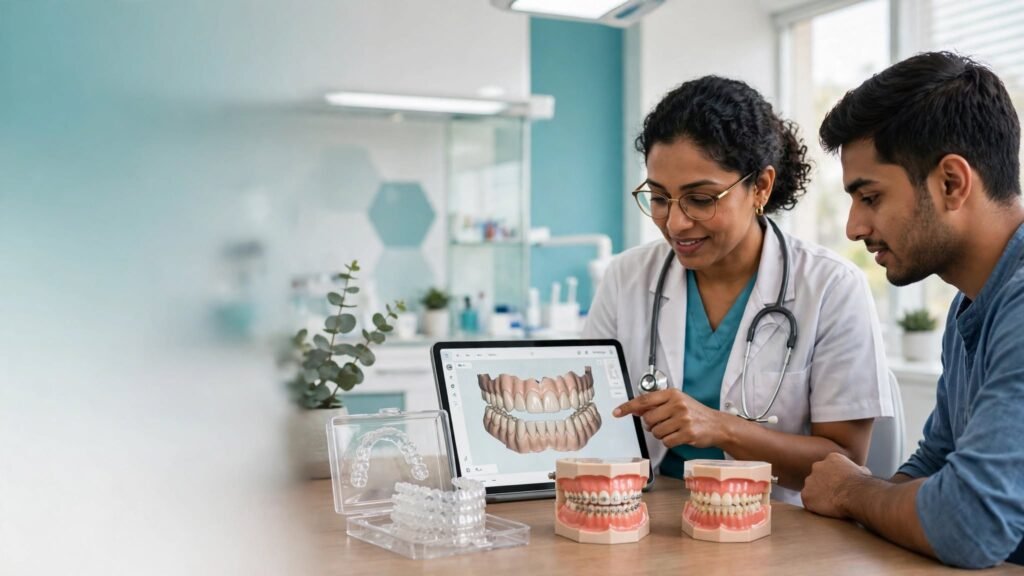
Traditional impressions use trays filled with putty, which many people find unpleasant. At our clinic, a 3D intraoral scanner creates a digital model of your teeth quickly and comfortably. That supports accurate planning and, with aligners, the design of your trays. It can also help you visualise the planned movement before treatment begins.
What to ask before choosing a provider
- Who plans my treatment, and who monitors it?
- Will I be examined in person, with X-rays and records, before treatment begins?
- What happens if my teeth don’t move as planned?
- Are refinements and retainers included?
- How often will I need to visit?
Be cautious about fully remote or mail-order aligner services that skip an in-person exam. Before any tooth is moved, the health of your gums and bone should be checked, and the movement should be monitored along the way. Without that, small problems can go unnoticed.
Common myths about braces and aligners
- “Braces are only for teenagers.” Adults can have orthodontic treatment too, provided their teeth and gums are healthy.
- “Aligners are always faster.” Speed depends on the case, not the appliance.
- “Straight teeth stay straight on their own.” Without retainers, teeth tend to drift.
- “Braces always mean extractions.” Some cases need them, but many don’t.
- “The most expensive option is the best one.” The best option is the one that matches your case.
The first weeks with braces or aligners
Expect some soreness for a few days after braces are fitted, or when you begin a new set of aligners. Soft foods help, and orthodontic wax can cover any bracket that rubs. If you wear aligners, keep a case with you so they never end up wrapped in a napkin and thrown away. Most people find it gets easier as they get used to it, but if something pokes, rubs or feels wrong, call us rather than waiting.
Don’t skip the retainer
Teeth have a habit of drifting back after braces or aligners come off. Retainers hold them in their new position, and your dentist will tell you how long and how often to wear them. They’re part of the treatment, not an optional extra.
Looking after your teeth during treatment
Braces and aligners don’t cause cavities, but plaque can build up around them if you’re not careful. Brush after meals, clean between your teeth with interdental brushes, avoid hard and sticky foods if you have braces, and keep your regular check-ups.
Book your orthodontic consultation
At Dr. Deodare’s Dental Care & Implant Center in Kothrud, we offer metal braces, ceramic braces, self-ligating braces and clear aligners. You’ll get an examination, a clear explanation of the options that suit you and a written plan.
Frequently Asked Questions
1. Which is better: braces or clear aligners?
Neither is better for everyone. Braces handle a wider range of complex cases, while aligners are discreet and removable but need discipline and suit selected cases. Your orthodontic examination will show which one fits your bite.
2. Can adults get braces or aligners?
Yes. Adults can have orthodontic treatment as long as their teeth and gums are healthy. Gum disease or cavities usually need to be treated first.
3. Does orthodontic treatment hurt?
Most people feel mild soreness or pressure for a few days after braces are fitted or tightened, or when they start a new set of aligners. It’s usually manageable and settles quickly.
4. How long does orthodontic treatment take?
It varies from several months for minor corrections to a couple of years for complex cases. Your orthodontist can give you an estimate after examining you, but the exact time depends on how your teeth respond.
5. How much does orthodontic treatment cost?
The cost depends on the type of appliance, how complex your case is and how long treatment takes. Metal braces are usually the most budget-friendly, while ceramic braces and aligners usually cost more. Ask for a written plan that shows the total cost.
6. Can clear aligners fix every problem?
No. Aligners work well for many mild to moderate cases, but some complex bite problems are better treated with braces or a combination of treatments. An honest assessment matters more than the product.
7. Will I need teeth removed for braces?
Sometimes, but not always. It depends on how much crowding there is and how the bite needs to change. Your orthodontist will explain whether extractions are needed in your case.
8. Do I need to wear a retainer after treatment?
Yes. Teeth tend to drift back toward their old positions, so retainers are an essential part of keeping your results. Your dentist will tell you how long and how often to wear them.
9. Can I eat normally with braces?
Mostly, but you’ll need to avoid very hard and sticky foods that can damage brackets or wires. With aligners, you remove them to eat and drink anything other than water, then clean your teeth before putting them back.
10. When should my child first see an orthodontist?
The American Association of Orthodontists suggests a first check-up around age 7. That doesn’t mean treatment starts then. It means problems can be spotted early and you can plan the right time.