
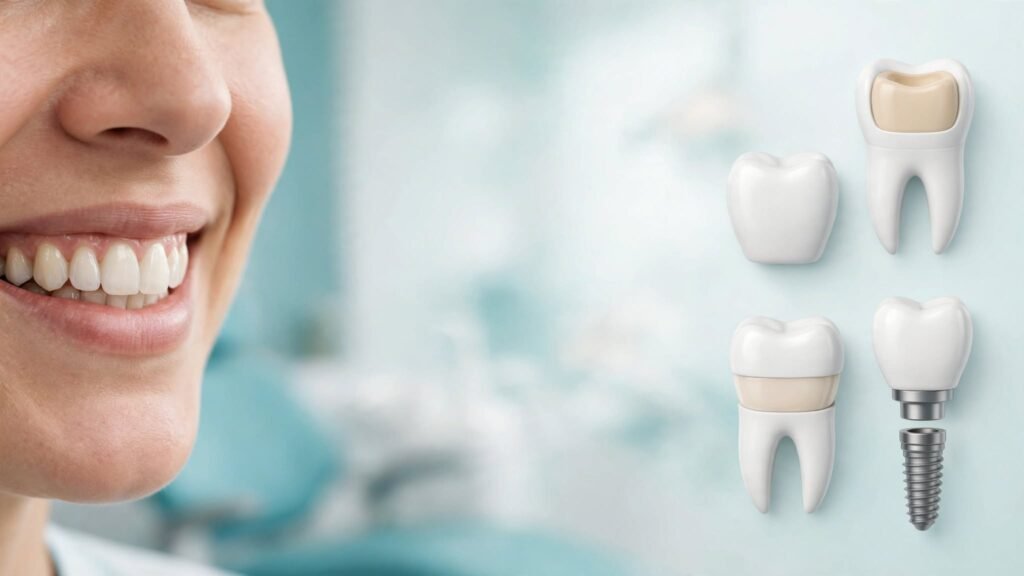
You bite into something hard and feel a sudden crack. Or an old filling comes loose while you are eating, leaving a rough gap for your tongue to worry at. Moments like these are more common than most people think, and they usually lead to the same question: what can be done to fix this tooth?
That is where professional restorative treatment comes in. In this guide, we walk through the main options, from fillings to implants, and explain how a dentist decides which one is right for you.
What Is Professional Restorative Treatment?
Restorative treatment covers the dental procedures that repair damaged teeth or replace missing ones. The goal is to restore how your teeth work (chewing and speaking), protect what remains of the natural tooth, stop damage from spreading, and make the tooth look natural.
Why does “professional” matter? A cavity that looks small on the surface may be much bigger underneath, which is why dentists use X-rays and careful examination. The right material, the right shape and a well-fitted finish all affect how long a restoration lasts. A badly fitted filling or crown can trap bacteria and lead to fresh decay.
Who Needs Restorative Treatment?
You may need restorative care if you have:
- A cavity or tooth decay
- A chipped, cracked or broken tooth
- Worn-down teeth from grinding or age
- An old filling that has broken, fallen out or is leaking
- A tooth that has had a root canal and now needs protection
- One or more missing teeth
Common Restorative Options
Fillings: composite and amalgam
A filling replaces the part of the tooth lost to decay. Composite fillings are made of a tooth-colored resin that is bonded to the tooth, so they blend in well and allow the dentist to keep more of your natural tooth. Amalgam fillings are a silver-colored metal alloy that has been used for a long time. They are less popular now because of their appearance, though they are still used in some situations.
Inlays and on lays
When a cavity is too large for a filling but the tooth does not need a full crown, an inlay or onlay can be the middle ground. These are made to fit precisely, usually from ceramic or composite, and they are bonded into or over the chewing surface of the tooth. They help preserve more of your natural tooth than a crown would.
Dental crowns
A crown is a cap that covers the whole visible part of a tooth. It is often used when a tooth is heavily decayed, cracked or weakened, or after a root canal. Crowns can be made from metal, porcelain fused to metal, zirconia or all-ceramic materials. Each has its own balance of strength and looks, so your dentist will recommend one based on where the tooth is and how you bite.
Root canal treatment and restoration
When decay or infection reaches the inner pulp of a tooth, a root canal treatment cleans and seals the inside so the tooth can be saved. It is done under local anaesthesia and is meant to relieve pain, not cause it. But it is only half of the story: the tooth then needs a proper filling or crown to seal it and protect it from cracking.
Dental bridges
A bridge replaces a missing tooth by attaching an artificial tooth to the neighbouring teeth on either side. It is fixed in place, so you do not remove it. The neighbouring teeth need to be reshaped to hold the bridge, which is something to think about.
Dental implants
An implant is a small post, usually titanium, placed in the jawbone to act like a tooth root. A crown is attached on top. Because it stands on its own, it does not rely on the neighbouring teeth. It needs enough healthy bone and gums, and there is a healing period before the final crown is placed.
Advanced 3D dental scanners
We have Advanced 3D dental scanners with high-resolution, three-dimensional digital models of your teeth, gums, jawbone, and nerves which can Help dental team to Plan Better Before Treatment.
Common Myths About Restorative Treatment
- “If it does not hurt, it does not need treatment.” Cavities can grow quietly and only start to hurt once they are deep. Many are found on a routine check-up.
- “Root canals are painful.” The treatment is done under local anaesthesia, and it is meant to relieve the pain that infection causes.
- “A crown or filling lasts forever.” Restorations can last a long time with good care, but they can wear, chip or develop decay at the edges.
- “Pulling the tooth is simpler.” Removing a tooth can lead to neighbouring teeth shifting and often means another treatment to replace it. Saving a tooth is usually preferable when it is realistic.
How Your Dentist Chooses the Right Treatment
There is no one-size-fits-all answer, but dentists usually weigh up the same factors:
- How much healthy tooth remains
- Where the tooth is in your mouth, since front teeth need to look good and back teeth need to be strong
- How hard you bite, and whether you grind your teeth
- The health of your gums and the bone around the tooth
- Your oral hygiene habits and any medical conditions
- Your budget and personal preferences
A good guiding principle is to choose the least invasive option that will do the job well, and to keep your natural tooth wherever that is reasonable. If you are unsure about a recommendation, it is perfectly fine to ask questions or seek a second opinion.
When to See a Dentist Instead of Waiting
Some problems can feel minor but should not be ignored. See a dentist soon if you have a persistent toothache, pain when biting, a chipped or cracked tooth, a lost filling or crown, swelling near a tooth, or a bad taste that does not go away. Early treatment is usually simpler, and it gives you more options.
The Treatment Process, Step by Step
Details differ by treatment, but a typical visit looks like this: an examination and X-rays, a discussion of your options, local anaesthesia to numb the area, removal of the decayed or damaged part, and then shaping and placing the restoration. Your bite is then checked and the surface polished. Fillings are often completed in a single visit, while crowns, inlays and onlays usually need more than one visit, with a temporary restoration in between.
Caring for Your Restorations
Restorations are strong, but they are not indestructible. Brush twice a day and clean between your teeth, because decay can start at the edges of a filling or crown. Avoid biting ice, pen caps or packaging with your teeth. If you grind your teeth at night, ask about a night guard. And keep up with regular check-ups, so small problems are caught early.
A Quick Note on Prevention
The best restoration is the one you never need. Brushing twice a day with fluoride toothpaste, cleaning between your teeth, limiting sugary snacks and visiting your dentist regularly all lower the chance of needing major work. When you do need treatment, catching the problem early usually keeps it simple.
Final Thoughts
Restorative treatment is really about giving you back a comfortable, natural-looking smile. The sooner a damaged tooth is looked at, the more likely it is that a simpler treatment will do. If you have a cavity, a cracked tooth or an old filling that is troubling you, book a consultation with Deodare Dental Care in Pune.
Frequently Asked Questions
1. How long do fillings and crowns last?
There is no fixed number. It depends on the material, how much of the tooth is involved, your oral hygiene, your bite and habits like grinding. With good care and regular check-ups, many restorations serve well for many years, but none are permanent.
2. Is restorative treatment painful?
Most procedures are done under local anaesthesia, so you should not feel pain during treatment. Mild soreness or sensitivity afterwards is common and usually settles within a few days. Tell your dentist if you feel discomfort at any stage.
3. Are tooth-coloured fillings better than silver fillings?
Tooth-coloured fillings look more natural and bond to the tooth, so less healthy tooth structure usually needs to be removed. Silver fillings are still used in some cases. Your dentist will recommend what suits your tooth and situation.
4. Do I need a crown after a root canal?
Often yes, especially for back teeth, because a tooth that has had a root canal can be more prone to cracking. A crown protects it. For some front teeth with plenty of healthy structure, a filling may be enough. Your dentist will advise.
5. What is the difference between a filling and an inlay or onlay?
A filling is shaped directly inside the tooth in one visit. Inlays and onlays are made to fit outside the mouth and then bonded in. They suit larger cavities where a filling would be too weak, but a full crown would remove too much tooth.
6. Can a cracked tooth be saved?
Sometimes. It depends on how deep and where the crack is. Small cracks may be fixed with a filling or crown, while cracks that go deep into the root may mean the tooth cannot be saved. See a dentist quickly, as cracks can worsen.
7. Should I choose a bridge or an implant?
Both replace missing teeth, but in different ways. A bridge relies on neighbouring teeth and is quicker, while an implant stands alone but needs enough bone and a healing period. Your dentist can guide you after an examination and X-rays.
8. Will my restoration look natural?
Modern materials can be matched closely to the color and shape of your teeth. Front teeth in particular are made with a lot of attention to appearance. Talk to your dentist about your expectations before treatment begins.
9. Is it normal to feel sensitivity after a filling?
Mild sensitivity to hot, cold or biting pressure is fairly common for a few days. If it is severe, lasts for a long time, or your bite feels uneven, go back to your dentist, since a small adjustment may help.
10. How do I know if an old filling needs to be replaced?
Signs include a rough edge, a chip or crack, food catching around it, sensitivity, or a dark line along the edge. Some problems are only visible on X-rays, which is one more reason to keep up with regular check-ups.
EDITOR’S NOTES (remove before publishing)
- Byline: add the author’s name and qualifications, plus a “Reviewed by” line naming the treating dentist or restorative specialist.
- Experience: add a short clinic-based insight, for example what you commonly see when patients delay treating a cracked tooth. Keep it anonymised.
- Sources to cite (verify before publishing): Indian Dental Association (IDA) and American Dental Association (ADA) patient-education resources on fillings, crowns, and implants.
- Statistics: none included on purpose. Restoration lifespans are described in general terms only. If you want to quote lifespans, use a named clinical source.
- Materials: confirm which crown and filling materials your clinic actually offers so the article matches your services.
- Internal links: restorative service page, root canal page, dental implants page, Blog 4 (cost and decision guide), and Blog 1 (fillings in children).
- Schema: Article and FAQPage.
- Images: original clinic photos or simple diagrams with descriptive alt text (for example, “tooth with a ceramic crown”).
- Originality: run the final text through a plagiarism checker before publishing.